

Paper isn't the enemy
6 of the 8 people I interviewed filled out check-in forms on paper. Before designing a replacement, I wanted to know why paper still wins.
Paper is both a frustration and a comfortable default.
When I started researching clinic check-in in January 2025, I assumed paper was the problem to solve. Then 6 of the 8 people I interviewed said they'd filled out their forms on paper. So why is it still everywhere?
Paper earns its place:
- Almost everyone knows how to use it.
- It's immediate: no logins, no downtime, no error messages.
- It doesn't need Wi-Fi.
Its costs are real too:
- Someone has to type it all in later.
- It can't translate. One participant was handed forms in a language he didn't read well.
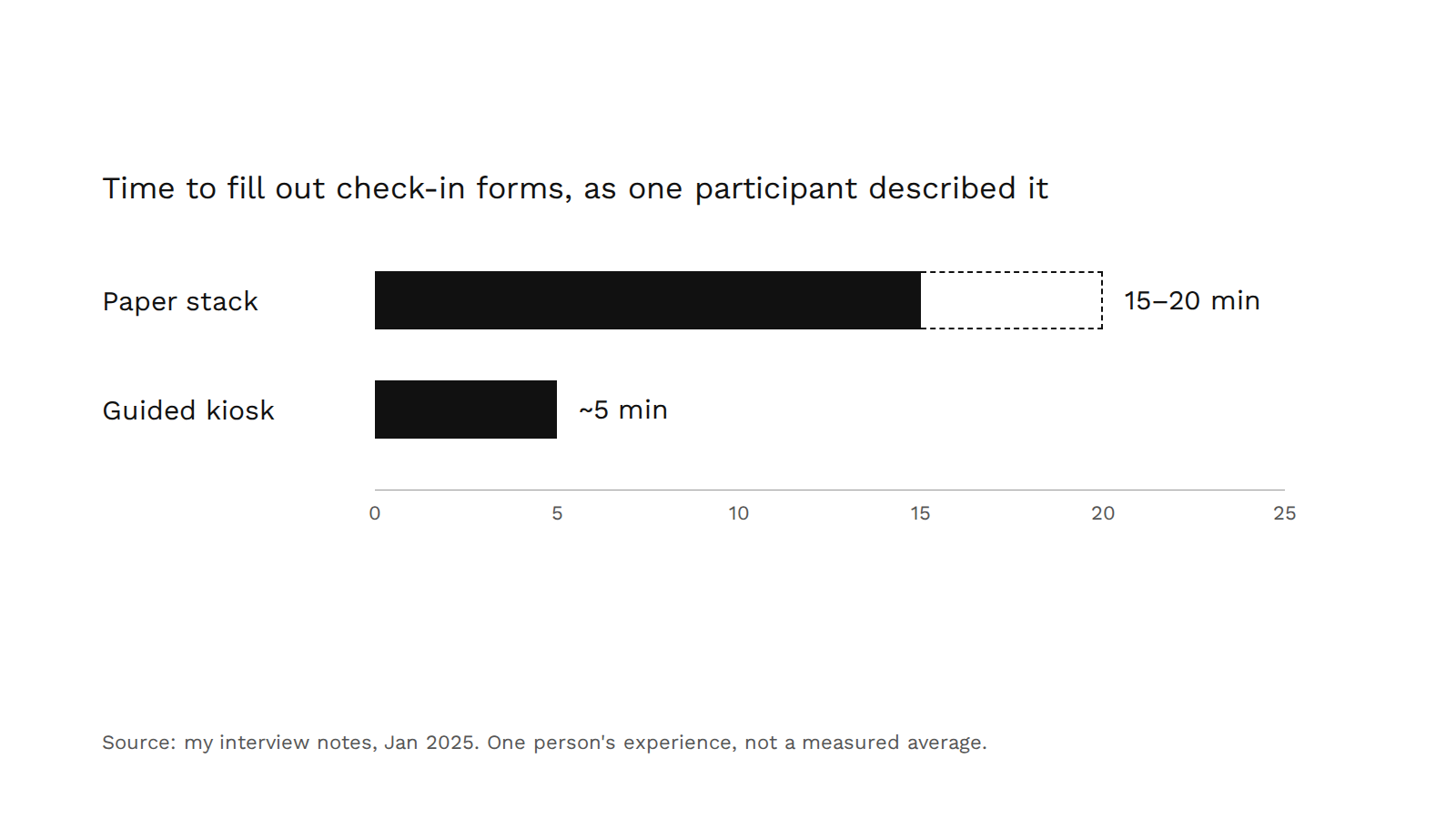
- It's slower: 15–20 minutes on a paper stack for one participant, versus about 5 at a guided kiosk.
- It feels like more. A thick stack with tight type looks like work before you start.
I see both sides at work, too. Customers come to us for a digital solution because paper has become too cumbersome. But I've also seen projects that didn't perform well, and the customer went right back to paper.
Paper is a source of frustration and a comfortable default at the same time. It may not belong at the front of the workflow anymore, but it's still the backup people trust.
So the goal shifted from "replace paper" to "earn the switch." Be as simple and reliable as paper, then add what it can't do: translation, guidance and a clear sense of how much is left.
What worked
What didn't
Paper is both a frustration and a comfortable default.